“I don’t have delusions of grandeur, I have an actual recipe for grandeur.” This is what Abe Sutton must have said when he pitched his CMMI ACCESS model idea, the first time anyone has tried to experiment with managing chronic care conditions with technology tools in the traditional Medicare program. He may have been inspired by the movie Limitless, where that line was spoken by actor Bradley Cooper in a clever story about how we can tap into our limitless brain power. Like the ACCESS model, the ability to engage more of your brain comes with risks alongside rewards. More in the One Thoughtful Paragraph below.
Some news highlights about other risks taken in health policy this week:
- HHS Secretary Robert F. Kennedy Jr. will risk being in the hot seat seven times over the next week as he appears before multiple Congressional hearings. If yesterday’s first two hearings were any indication, he will face tough questions about vaccines, budget and staff cuts, and his MAHA movement.
- There are both risks and rewards to excluding certain health care wearables (i.e., screening tools, fitness coaches) from FDA oversight as clinical-grade medical devices. The U.S. House Energy & Commerce Health Subcommittee explored this at a legislative hearing on April 15, 2026, including a bill introduced by Representative Balderson (R-OH) that proposes to codify an exclusion for general wellness devices in the FDA’s recently updated guidance. (See Rep. Balderson’s op-ed about wearables here.) Consumer Technology Association’s René Quashie testified on behalf of the industry about wearables.
- CMS is taking a risk in its assumption that payers will be able to extend their plans to implement electronic prior authorization to drugs by October 2027. On April 10, 2026, CMS released a new proposed rule that would require payers to expand their existing prior authorization APIs (already required for non-drug items and services under the 2024 ePA final rule) to incorporate drugs covered under a medical benefit by October 1, 2027. Comments are due June 15, 2026. More here.
I wasn’t high, I wasn’t wired, just clear. I knew what I needed to do, and how to do it. Is this what Abe Sutton thinks when he gets up in the morning? This may be a line from the movie Limitless, but at the rate the CMMI Director is releasing new Medicare reimbursement pilot programs, it may be his internal dialogue about his limitless brain power. This week, CMMI announced the applicants accepted into the ACCESS model (it is quite the list – and they’re not done yet; the application deadline has been extended to May 15, 2026). Lots of smart people are already weighing in on what this means (see here, here, here), and it’s clearly a mixed bag of risks and rewards (just like the Limitless movie premise of having a pill that allows you to access 100% of your brain power – you should watch it, good flick). But I will say this: the ACCESS model is a turning point in American health care financing. Until now, only direct-to-consumer and concierge doctor-type-shops have attempted what ACCESS is trying to do – getting a set amount of money every month per patient to continuously KEEP them healthy- not just treat them when they’re sick. Our financing system is normally all about paying for one visit, one procedure, one drug – which has incentivized everyone trying to get paid for more of those things and ignoring how to keep people from getting those things in the first place. The ACCESS model formalizes what only entrepreneurs have tried so far – monitoring people all the time so they can prevent bad health conditions from getting worse. Wow. It is like our hero says in the Limitless movie: I was blind, and now I see.
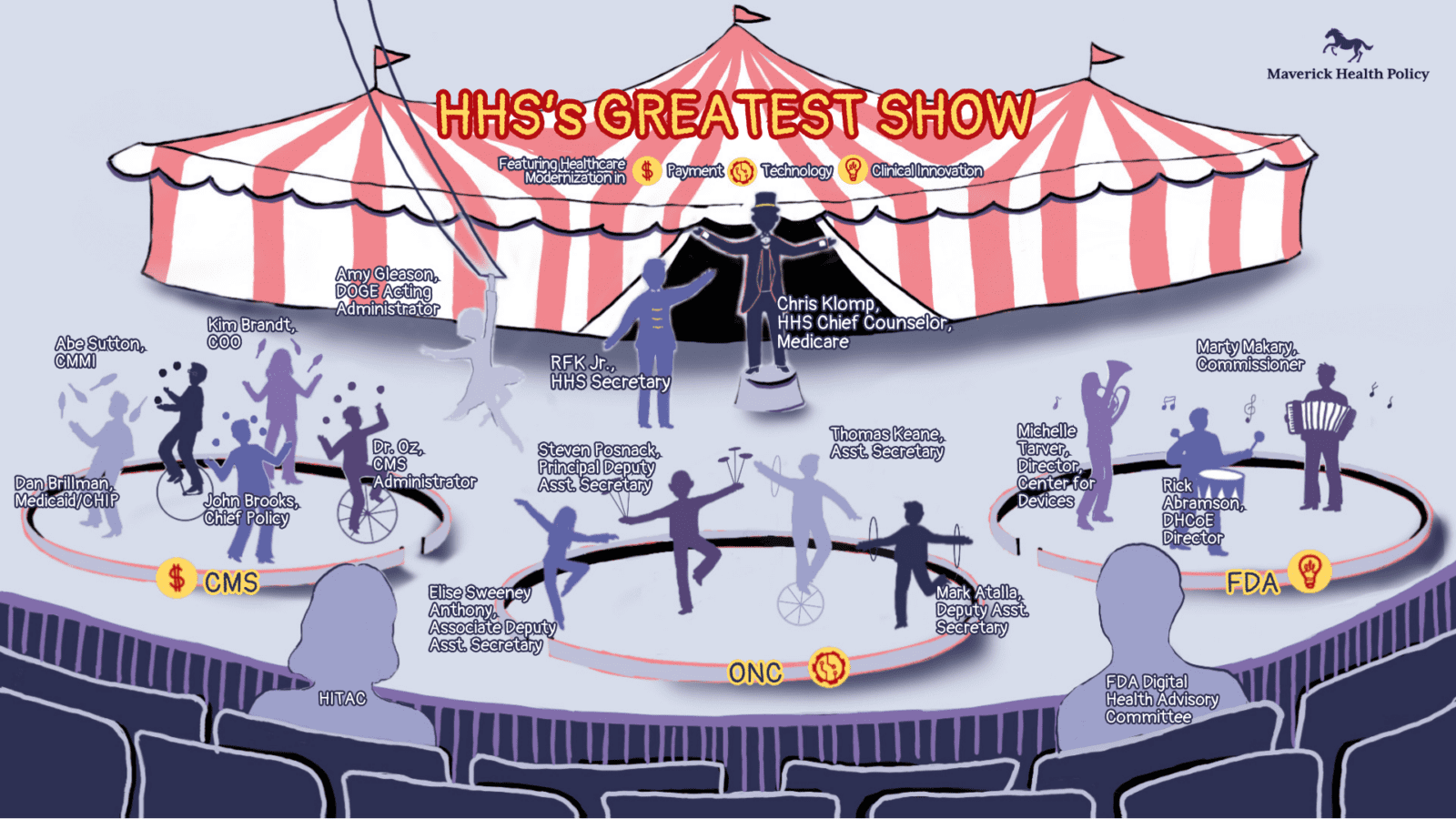
Did you miss our quarterly update? It is not too late to subscribe to MyMaverick to get the information, featuring our who’s-who in HHS’ Greatest Show visual here: