August 9, 2026 | 5 min read
Maverick Minute
State Health AI Legislative Activity: Q2 2026
Table of Contents
Overview
In the second quarter of 2026, state-level activity continued to define the responsible use of AI in health care in the absence of a federal regulatory scheme.
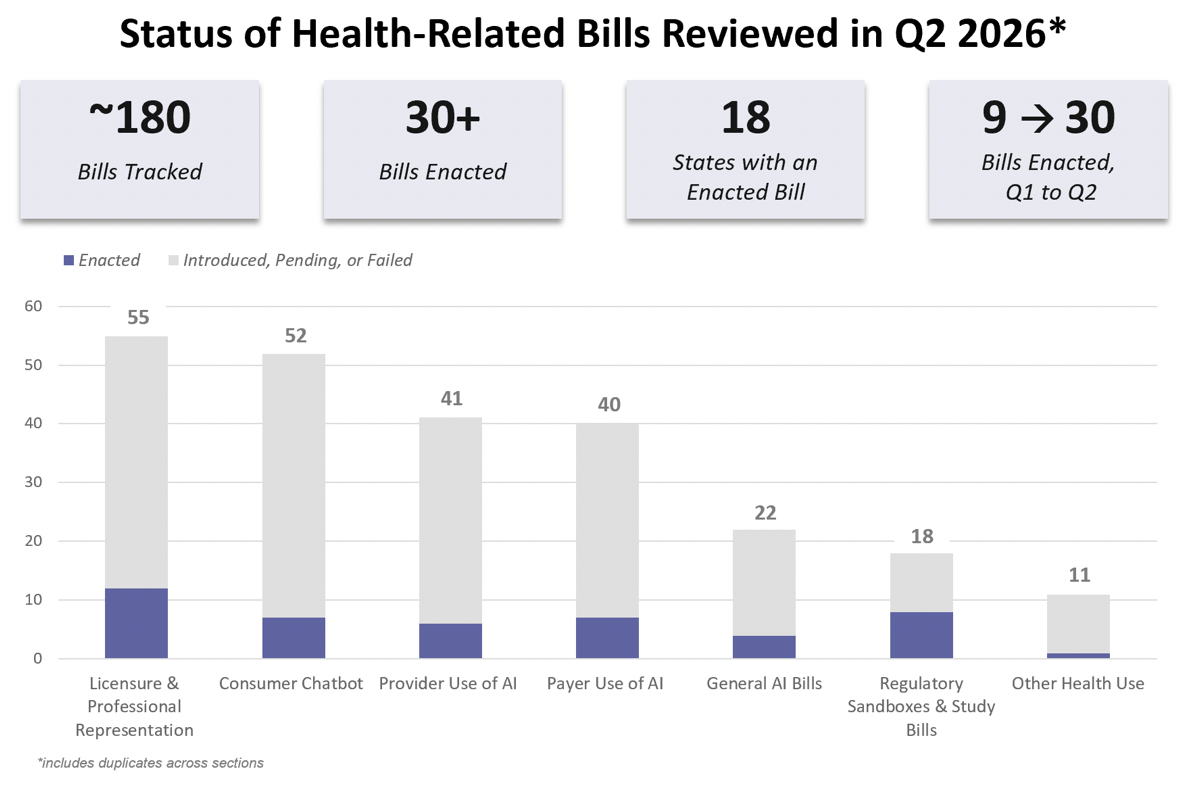
WHAT: Maverick tracked approximately 180 active bills between April 1 and June 30, 2026, continuing the pace of activity from the first quarter of the year. State lawmakers enacted over 30 of these tracked bills – more than triple the number of bills enacted in Q1 2026.
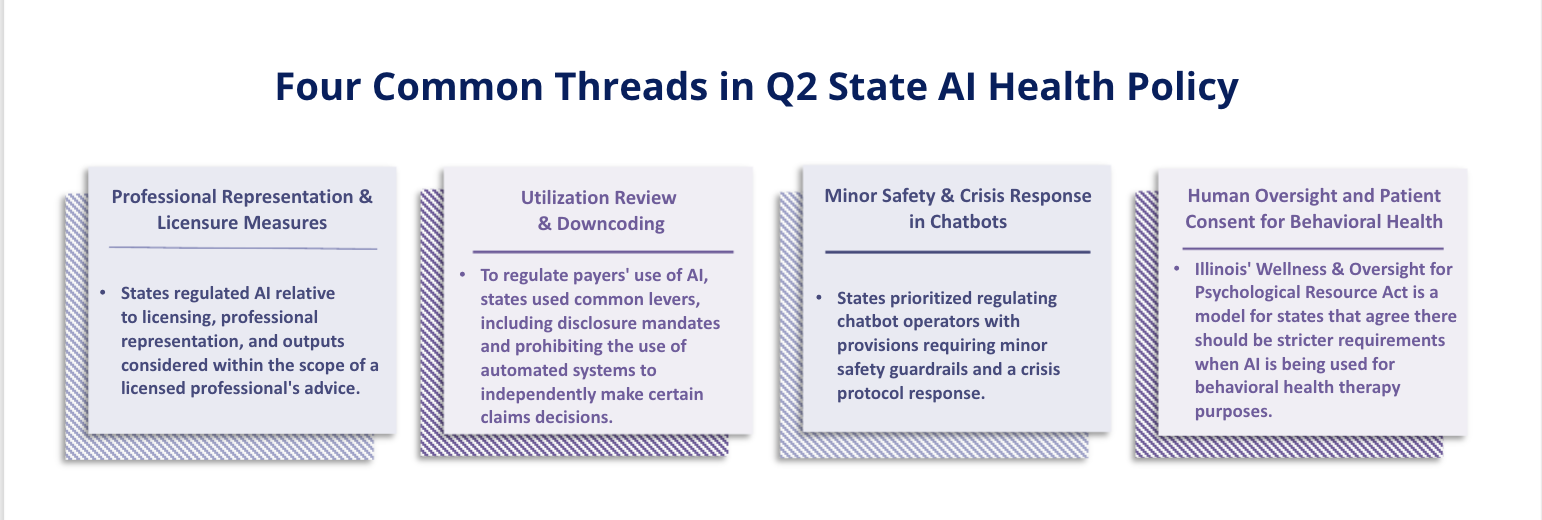
IN BRIEF: State legislative activity in Q2 2026 continued to focus on use-specific and context-specific approaches to regulating the use of AI in health care. States are focused on specific applications of AI (e.g., mental health, benefit and coverage determinations, clinical care) and assign responsibility through mechanisms like transparency, disclosure, and oversight requirements. States also focused on technology-specific measures (i.e., bills regulating the type of AI), with bills designed to address chatbot functionality, capability, and use patterns. The higher the risk posed by the AI use or technology, the more requirements states imposed; systems that interact with minors, purport to offer professional advice, or support mental health services would face more restrictions and rules. In clinical settings specifically, states are deciding that AI may assist licensed professionals but should not replace or displace human judgment that impacts patient care. Medical boards, sandbox administrators, and courts are also weighing in about the use of AI for clinical purposes.
WHEN: Maverick tracked activity between April 1 and June 30, 2026. At the end of this quarter’s legislative cycle, only a few state legislatures remain in session. California, New Jersey, and New York are expected to be the most active for the remainder of 2026.
Highlights
- Clarifying providers permitted uses of AI: Maverick tracked 41 total bills in Q2 that regulate how licensed health professionals, and the facilities deploying AI on their behalf, use AI in patient care. Of those bills, six were enacted. While states have not reached consensus for how providers should and should not use AI, Q2 reflects heightened efforts to define the appropriate role of AI in clinical care and professional practice.
- California AB 1979, which would prohibit AI from performing tasks reserved for licensed professionals, has drawn criticism from Epic, Kaiser Permanente, California Hospital Association, and other groups that argue broad language would require health care systems to redesign audit and compliance processes to demonstrate “independent professional judgement” for tools embedded across clinical operations.
- Illinois offers a scalable, mature model: Several states continued to advance similar, if not exact copies of, the Illinois Wellness and Oversight for Psychological Resources Act, enacted August 4, 2025. Maverick tracked 20 bills with similar mental and behavioral health-specific AI use provisions in Q2, three of which were enacted. This Q2 activity confirmed that Illinois’ legislation was not just an isolated state experiment, but an applicable model for regulation. These bills are tailored to target both the technology type (by prohibiting AI from providing, advertising, or offering therapy services) and the deployment context (by regulating how licensed professionals deploy AI in clinical practice).
- States’ interest in regulating payers’ use of AI persists: State legislatures’ priorities continued to focus on governing how payers use AI in payment and benefit determinations – particularly with utilization management, prior authorization, and downcoding processes. Maverick tracked 40 total bills with related provisions, seven of which were enacted. The volume of bills and common provisions illustrate policymaker concerns of AI’s impact on patient access to care and provider reimbursement.
- Chatbots posing as licensed professionals: In addition to federal efforts, such as the GUARD Act, which requires chatbots to disclose their non-professional status to users, state bills increasingly targeted chatbots that impersonate licensed professionals, such as doctors, lawyers, or mental health providers. These provisions address concerns related to consumer deception and the unauthorized practice of medicine.
- Activity beyond state legislatures: Medical boards, sandbox administrators, and courts are gradually becoming arbiters of clinical AI use. Examples include: the Federation of State Medical Board’s new AI workgroup, and the Washington Medical Commission’s proposed policy statement saying AI cannot be licensed to practice medicine. Litigation may also lead to decisions that address concerns with the application of AI in health care. The State of Pennsylvania’s lawsuit against Character Technologies underscored professional representation concerns, alleging the chatbot misrepresented itself as a licensed medical professional. Sutter Health is facing a class action lawsuit, highlight concerns related to ambient scribes, that alleges the health system shared patient-clinician conversations recorded with ambient technology to a third-party processing system without proper consent.
- States that want to explore implementation of emerging technologies through sandboxes and the licensing boards charged with protecting patient safety are not aligned, which creates real deployment risks in states positioning themselves as AI-friendly. This was evidenced when Utah’s Office of AI Policy was scrutinized for running an autonomous prescription-renewal pilot program without first consulting the state’s medical licensing board.
Maverick’s Perspective 💡
Congress is unlikely to preempt state law in the near-term, and HHS will likely leverage its existing — but limited –authority to clarify its oversight of health AI. In lieu of a uniform federal approach, states governments – through its legislatures and medical boards and other offices — will continue to oversee health AI models, particularly for use cases related to clinical functions and the practice of medicine.
Stakeholders must prepare now for the anticipated 2027 state AI activity. This includes monitoring high-impact health AI bills, creating policy positions and public statements that are both affirmative and defensive to coordinate external communications that impact the public’s perception about new technology, lobbying legislators and engaging with state medical boards and other influencers to inform policy development, and preparing compliance teams to navigate state-by-state requirements as enacted bills’ reach implementation dates. It will be difficult to pivot as quickly as necessary without planning for the changes now. It will be impossible to shape the rules that will govern autonomous AI use, human review of AI outputs, and standard of care or liability regimes without leaning in now.
Last Updated on August 21, 2026
Contact Us
Have any questions? We'd love to hear from you.